ExperienceKit: How NGOs Can Launch Campaign Pages in Hours, Not Weeks

Your next campaign launch does not have to stall on the landing page. You describe it the way you would brief an agency (audience, goal, story, call to action), and minutes later a production-ready page sits in your own Drupal site, built only from your organization's approved components, on brand and accessible from the first draft, ready to publish the same day.
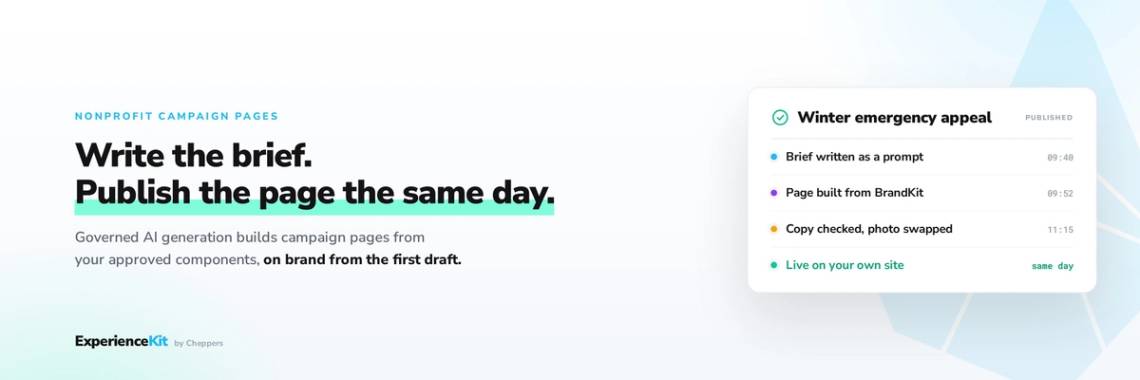
This post is part of the ExperienceKit series. New to ExperienceKit? Start with the introduction, which the whole series builds on.
That workflow exists today. This article covers why nonprofit campaign landing pages still take weeks, what the wait costs your organization, and how AI page generation changes the math for communications teams that don't have developers to spare.
The three-week landing page, and why it keeps happening
Most NGO communications teams know this cycle by heart. A campaign is coming: a fundraising push, an awareness week, a policy moment. The campaign needs a landing page. And so begins a process that has almost nothing to do with the campaign itself.
Every page starts as a ticket
The communications lead writes a brief. The brief becomes a request to whoever builds pages: an in-house developer if the organization has one, an agency retainer if it doesn't, a volunteer if it has neither. The request enters a queue behind everything else that person is responsible for: the website's security updates, the broken donation form, the last campaign's leftover fixes.
Then the back-and-forth starts. The first draft doesn't match the brief. The image is wrong. The donation block needs to move up. Each revision costs another cycle through the queue. The page represents perhaps two days of actual work, yet it stretches across three or four weeks of calendar time, because the work is sliced across handoffs and every handoff waits. Nobody involved is slow.
Every campaign starts from scratch
Most of these pages have been built before, and that should bother us more than it does. The hero with the campaign image, the story section with a beneficiary quote, the statistics band, the donation call to action, the email signup: your last five campaigns used some arrangement of the same elements, yet each new page was assembled by hand, from zero, as though the organization had never made one.
Starting from scratch is slow, and it is where inconsistency creeps in. One campaign's donate button is green, the last one's was orange. One page uses the current logo, another an old export someone had on their desktop. Each of these is a small thing on its own, but together they add up to a brand eroding one urgent deadline at a time.
The real cost is the missed moment
For a business, a slow landing page costs revenue. For an NGO, it costs the moment, which is often the whole point of the campaign.
A crisis breaks and public attention surges for days, sometimes hours. A news story puts your issue on the front page. A matching-gift donor gives you a two-week window. In each case, the value of a landing page decays fast. A page that goes live in week three of a two-week window is pointless. Communications teams know this, which is why they end up doing things they'd rather not: publishing a bare-bones page that undersells the campaign, sending traffic to a generic donate page that converts poorly, or reaching for an off-platform page tool that solves speed by sacrificing brand, data, and consistency.
None of this is a failure of the team; these are rational responses to a process that can't move at the speed the mission requires.
What changes when AI generates the page
The fix is to remove the ticket queue from the path entirely, at least for this category of work.
With AI page generation, the communications lead writes the same brief they always wrote. But instead of filing it as a ticket, they write it as a prompt:
"A landing page for our winter emergency appeal. Lead with the crisis and one family's story. Include what donations fund at three giving levels, a matching-gift banner, and a donation form above the fold on mobile."
This is exactly what ExperienceKit does. CampaignKit, its generation engine, turns that prompt into a page in minutes: a real, production-ready page in your CMS rather than a mockup. They review it, adjust the copy, swap a photo, and publish.
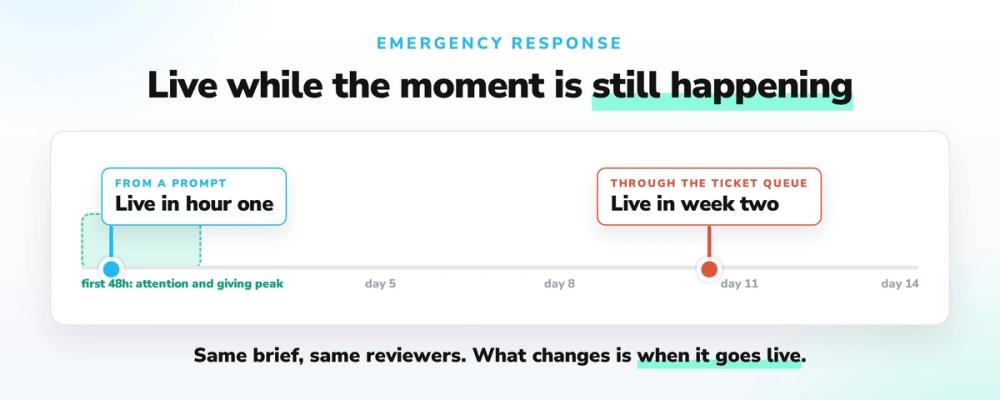
The brief didn't change, and neither did the skill required to write it. If anything, the person closest to the campaign now shapes the page, which is where that judgment always belonged. What collapsed is the three weeks between writing the brief and going live: that is now an afternoon.
It's worth being precise about what AI is doing here, because "AI makes web pages" describes a lot of tools, and most of them are wrong for an NGO. Generic AI builders make up each page from scratch: invented layouts, whatever design the model felt like that day. Fast, yes, and completely disconnected from your brand, your website, and your standards. That speed just creates a different kind of problem.
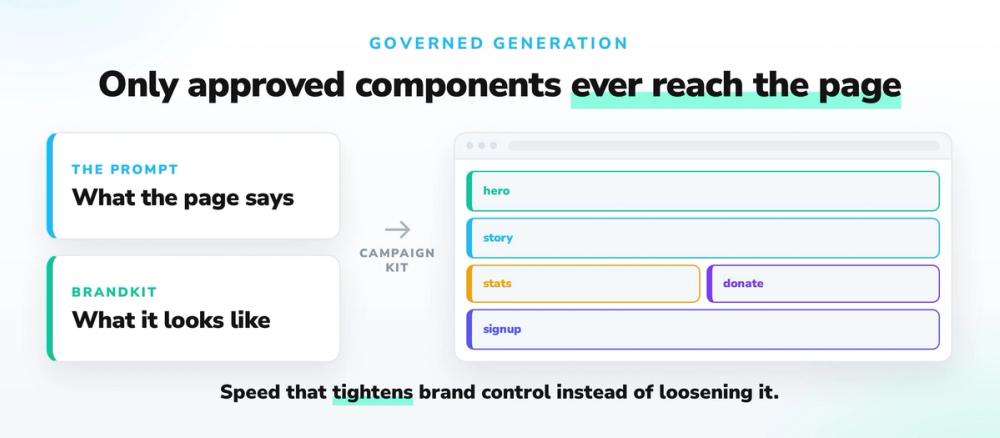
Governed AI generation works differently. CampaignKit builds pages exclusively from your approved components: the hero, story block, donation call to action, and signup form from BrandKit, a governed component library we build for your brand, living in your Drupal site. The prompt decides what the page says and how it flows. BrandKit decides what everything looks like and how it behaves. Because generation draws only from approved components, every page comes out on brand and accessible.
Two scenarios where hours matter
Emergency response
A natural disaster strikes a region where your organization works. Public attention and public generosity peak within the first 48 hours.
The old timeline: the emergency appeal goes out by email and social media on day one, pointing to the generic donate page, because that's what exists. The dedicated landing page (the one with situation updates, field photos, and a specific ask) arrives in week two, after the urgency has faded and with it the giving.
The new timeline: within an hour of the response decision, someone on the communications team prompts a page into existence: situation summary, what your teams are doing on the ground, exactly what a donation funds, urgent call to action. It's reviewed and live before the first press cycle ends. When updates come in from the field, updating the page is a quick edit instead of another ticket. The organization communicates at the speed of the crisis instead of the speed of its queue.
The fundraising calendar
The fundraising calendar is predictable: year-end giving, Giving Tuesday, spring appeals. But the workload spike it creates is brutal for small teams. Every campaign wants its own page; some want several: one framed for lapsed donors, one for monthly-giving prospects, one for the corporate-matching audience.
When each page is a multi-week project, teams triage: one page per campaign, no variants, no segment-specific framing, because the capacity for more isn't there, however much better the variants would perform. When a page is a prompt, the triage disappears. Three audience-specific versions of the year-end appeal is an afternoon's work. Testing a different story lead is a follow-up prompt. The team's fundraising strategy is finally expressed on the website at full resolution, instead of the compressed version their page-building capacity allowed.
There's a planning benefit hiding in here too. When pages are cheap to produce, they become cheap to plan late. The partnership that confirms in November can still get its own page before year-end. The story that emerges from the field mid-campaign can become a page while it's still news. Campaign planning stops being constrained by a production schedule set months in advance, and starts following what the campaign actually needs.
The donor-trust angle: why "on brand" is not a cosmetic concern
For an NGO, brand consistency is the visual layer of donor trust.
A donor deciding whether to give is, in that moment, deciding whether your organization is legitimate and competent. A campaign page with the wrong logo, mismatched colors, or a layout that looks nothing like your main website introduces exactly the doubt you can't afford, especially in an emergency appeal, where scam pages are circulating and donors are on guard. People give to organizations that look like they have their act together, because looking like it is the only evidence available at the moment of the gift.
This is where the speed conversation usually collapses for nonprofits. Every fast option they've tried (external page builders, borrowed templates, general-purpose AI tools) bought speed by loosening brand control. The pages went up quickly and looked like they came from somewhere else.
Governed generation is the first fast option that tightens brand control instead of loosening it. Because every page is assembled from the same approved BrandKit components, every campaign page is automatically consistent: with your main website, with the last campaign, with the next one. The donation experience a supporter had in March looks and works the same in November. Accessibility, too, is carried in the components rather than depending on whoever built the page that week. That matters both for the donors who rely on it and for the funders who increasingly ask about it. Consistency stops being an aspiration your team enforces page by page and becomes a property of how pages are made.
What this means for the people involved
A fair question from any team hearing this: what happens to the people who used to build these pages?
They stop being a bottleneck for work that never needed their full attention, and keep doing the work that does. Developers still decide what goes into BrandKit: what a donation block is, how the hero behaves on mobile, what the accessibility standards are. That's the high-leverage work: decisions made once that every future page inherits. What they stop doing is assembling the fourteenth variation of the same campaign page while real development work waits.
Editors get the best version of their job. The layout wrangling and markup fixes that used to eat their afternoons are carried by the components, so their attention goes where an editor's attention belongs: the story, the tone, the accuracy of every claim, and the final read before anything goes live. A generated page still needs the eye that catches a wrong figure or a headline that misses the audience, and that eye is what editors bring.
Communications teams, meanwhile, don't need new technical skills. The prompt is the brief they were already writing. The judgment that matters (which story leads, how the ask is framed, what this campaign's audience needs to hear) was always theirs. Now it reaches the published page without dilution through handoffs.
Nobody on the team is replaced; the waiting is what goes away.
For a small NGO, this is also a resilience question. Teams of three can't afford a single point of failure, yet page production is usually exactly that: one person or one agency contact who knows how the site works. When pages come from prompts against a shared component library, the capability belongs to the whole team instead of whoever happens to hold the technical knowledge that month.
What to look for if you're evaluating this
If your organization runs on Drupal, as many NGOs do, here is a short checklist for evaluating AI page generation:
- Real pages in your CMS. Generated pages should be native content in your Drupal site: on your domain, in your analytics, in your editorial workflow, with no exports, embeds, or shadow sites on someone else's platform.
- Generation from your components only. Ask directly: does the tool make up each page from scratch, or does it only compose your approved components? This single question separates governed generation from tools your technical and brand people will (rightly) veto.
- Accessibility at the component level. If accessibility is built and audited into each component, every generated page inherits it. If it's checked page by page after the fact, speed will outrun compliance.
- No lock-in. The component library should be standard Drupal SDC living in your own codebase, components you own, kept updated as support rather than held hostage. If the tool disappeared tomorrow, your components and pages should still be yours.
ExperienceKit was built to this checklist. CampaignKit generates production-ready Drupal landing pages from a prompt, built entirely from BrandKit, the governed component library we build for your brand. Your communications team gets the speed. Your brand, your developers, and your donors get pages the organization can stand behind.
The next moment that matters for your mission is already on its way, and this time the landing page can be ready for it.
See it happen
Book a 30-minute demo and watch a campaign brief become a live, on-brand Drupal landing page, in the time it used to take to file the ticket.
Related posts
Your marketing team needs a landing page for next month's campaign. Today that means a brief, a ticket, a spot in the developer queue, and a few weeks of waiting. ExperienceKit turns it into a sentence. Describe the page, and AI generates it in your Drupal site: production-ready, on brand, and built entirely from a governed component library, one built on your brand and delivered as part of the solution. This post introduces what ExperienceKit is, why we built it, and what the rest of this series will cover.
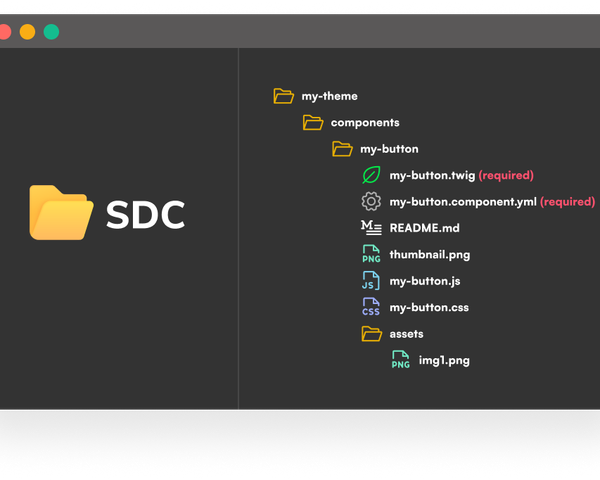
Single Directory Components (SDC) are the biggest change to Drupal theming in a decade, and one of the quietest. There was no page-builder launch, no new screen to learn, just a simple answer to a question Drupal front-end developers had been asking for years: why are all the pieces that make up one part of a page scattered across five different folders?