ExperienceKit: AI Content Governance - A Practical Framework for Digital Teams

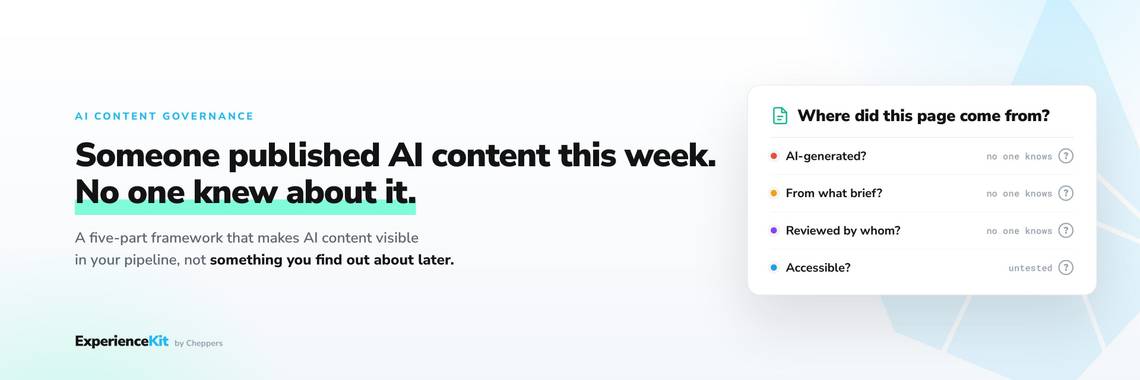
Somewhere in your organization, someone put AI-generated content on your website this week. Nothing marks those pages as AI-generated, and no record exists of which tool produced them, from what prompt, or who checked the result before it went live. Closing that gap is what AI content governance is about.
This post is part of the ExperienceKit series. New to ExperienceKit? Start with the introduction, which the whole series builds on.
Neither of the obvious responses works. A ban fails because the tools are free, useful, and already open in your colleagues' browsers, so all a ban removes is your visibility into what gets published. Blanket permission fails because ungoverned AI output carries real institutional risk: off-brand pages, invented claims, inaccessible markup, and no record of how any of it reached your site.
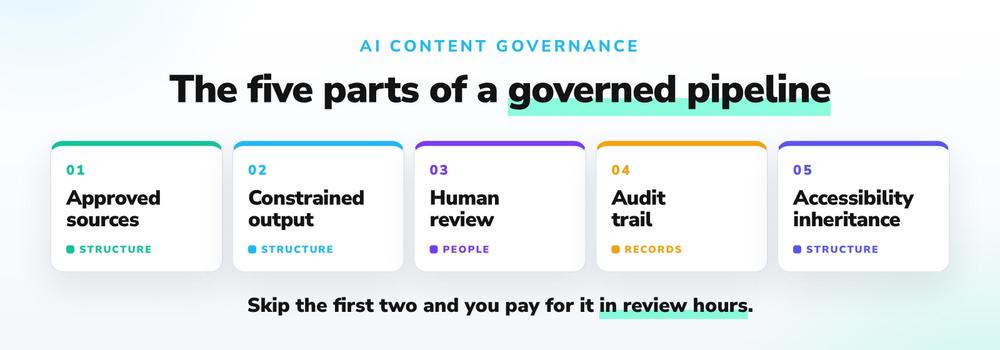
What works is the same thing that works for every other production system: governance built into the pipeline, so the easy way to publish is also the safe one. This article lays out a five-part framework for AI content governance that digital teams can apply regardless of which tools they use, and then shows what the framework looks like when a solution implements all five parts natively.
Interested in AI and governance in mission-driven organizations? We wrote a book about exactly that: AI & Drupal for Mission-Driven Organizations.
Governance must live in the system, not in a memo
One principle underlies everything that follows: a rule that depends on people remembering it will get broken; a rule enforced by the system's structure holds.
Content teams have known this for years. Organizations build themes where brand colors are the only colors, instead of asking editors to remember them. They build workflow states that make publishing without review impossible, instead of asking for review. AI content deserves the same treatment. The policy document has a role (it records intent and assigns accountability), but the enforcement has to live in the tools, because AI multiplies content volume faster than any review team scales.
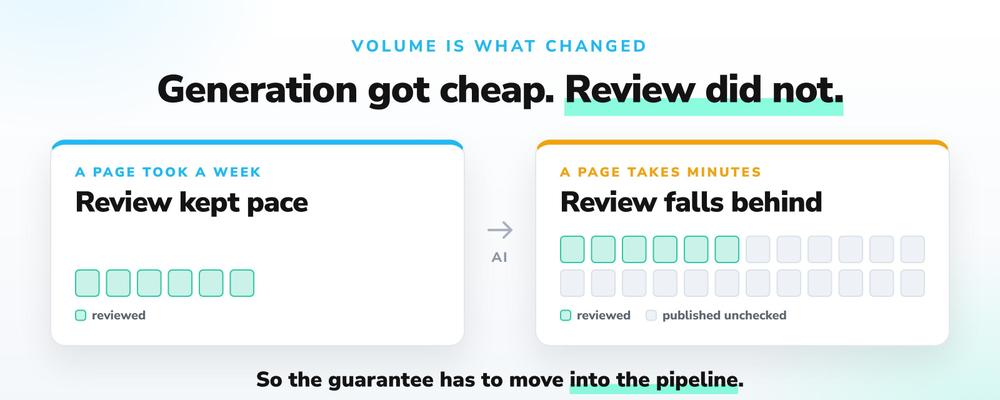
Volume is what makes AI different here. When a page took someone a week to produce, review kept pace with production on its own, and spot-checks caught most of what slipped through. Now that a page takes minutes, your colleagues can produce far more than anyone can review, and hiring more reviewers will not close the gap. If your governance depends on inspecting every page after the fact, it was struggling before AI and it will not keep up now.
The five-part framework
1. Approved sources: AI draws only from what you've sanctioned
The first question for any AI in your content pipeline: what is it allowed to build from?
Ungoverned tools build from everything: the open internet's patterns, their training data's habits, whatever visual and verbal conventions they absorbed. That is why their output feels generic and drifts off brand: your organization's standards are, at best, a soft influence among many.
Governed AI inverts this. The inputs are an explicit, sanctioned set: your approved components, your content model, your brand language, your approved assets. Practical tests for any tool you evaluate:
- Can we list what the tool builds from, or is it "the model plus a style hint"?
- Who controls that set, and through what process does something get added?
- When our standards change, does the tool's source set change with them automatically?
If you cannot list the sources, everything downstream is cleanup rather than prevention.
2. Constrained output: even the worst result stays on standard
The second question: how bad can the output get?
This is the sharpest dividing line among AI content tools. Most invent each page from scratch (its own structure, its own layout, its own styling) and then invite you to review the result into compliance. At any real volume that review never catches up, for the reason above: generation is nearly free and reviewer hours are not.
Constrained generation flips the guarantee. If AI can only assemble pages from approved building blocks (components, layouts, templates), then even its worst output is still on standard. This is the exact purpose we built BrandKit for: a governed library of Drupal Single Directory Components we build for your brand, so generation has nothing to draw on except approved parts. Brand review shifts from "inspect everything for visual violations" to "the visual layer is handled; review the message."
The evaluation question: what does this tool's failure look like? If a weak generation gives you a plain but on-brand page, the tool is governable. If it gives you a page the model invented from scratch, no policy will keep up.
3. Human review: AI drafts, people publish
Structure can guarantee a lot, but it cannot guarantee judgment. That is what the third part protects.
Constrained output guarantees the form of a page and says nothing about its truth. An AI can produce a perfectly on-brand page stating the wrong tuition fee, an unverified claim, or a tone-deaf headline. The governance answer is a hard rule: AI output is always a draft. A named human reviews it, edits it, and takes accountability for publishing, the same accountability chain that governs human-written content.
Two implementation details make this real rather than ceremonial:
- Review happens inside the workflow itself. AI drafts should enter the same editorial pipeline as everything else: same states, same permissions, same approvals. A bolted-on review step gets skipped under deadline pressure; a built-in workflow state offers no way around it.
- Review must be proportionate to what remains unguaranteed. When parts 1 and 2 secure the visual and structural layer, reviewers can spend their limited attention on accuracy, tone, and intent. That focus is what constrained generation buys them, which is why the two parts belong together.
The division of labor works out well, too. AI takes over the assembly and the waiting; people keep the judgment and the decision to publish. Review stays a real editorial job rather than turning into rubber-stamping.
4. Auditability: you can always answer "where did this page come from?"
The fourth part is the one leadership will eventually ask for, usually at a bad moment: a complaint, a compliance question, a board member reading about AI risk. The organization must be able to answer, for any piece of content: was this AI-generated, from what input, approved by whom, and when?
Minimum viable auditability:
- Provenance: which pages were AI-generated, recorded in the system rather than remembered by whoever was there.
- Inputs: the prompt or brief that produced each generation.
- Chain of approval: who reviewed, who edited, who published; mature CMS workflows already capture this, provided AI content flows through them rather than around them.
Auditability is also self-defense for the AI initiative itself. When someone asks whether AI content is hurting quality, a team with provenance data can answer with evidence. A team without it has anecdotes, usually offered while the whole initiative is under fire.
5. Accessibility inheritance: decided once, inherited by everything generated
Accessibility earns its own pillar because it is where AI-scale content collides hardest with page-by-page assurance. If every generated page can contain novel markup, every generated page needs its own accessibility audit. At AI generation speed, the audit backlog becomes unpayable within months. For universities, NGOs, and public-sector organizations with legal accessibility obligations, that amounts to a compliance program failing in slow motion.
The scalable model is inheritance. Accessibility is engineered and audited once, at the component level (semantics, contrast, focus behavior, keyboard support), and every page assembled from those components inherits the result. The audit surface stays fixed (dozens of components) while output grows without bound. Content-level checks remain (alt text quality, link text, reading order make sense only in context), but they ride on a structural floor that generation cannot break. The evaluation question: does generating ten times more pages create ten times more accessibility risk? Under inheritance, the answer is no.
Putting the framework to work
Five questions, one per pillar, for any AI content tool or process you evaluate:
- Sources: Can we list and control what AI builds from?
- Constraint: Is off-standard output impossible, or merely discouraged?
- Review: Does AI content flow through our real editorial workflow, with a named human accountable for publishing?
- Audit: Can we reconstruct provenance (prompt, generation, approvals) for any page?
- Accessibility: Is accessibility inherited from audited building blocks, or re-verified page by page?
A tool that fails 1 and 2 forces you to compensate with heavier 3 (more human review), which surrenders most of the speed you adopted AI for. The pillars are load-bearing together: structure (1, 2, 5) guarantees what structure can, so that people (3) and records (4) can cover what it cannot.
A practical rollout sequence
For teams introducing the framework, an order of operations that avoids both paralysis and free-for-all:
- Write down the source set first. Before touching tools, agree on what "approved" means in your organization: which components, which brand language, who owns changes. This is also where ExperienceKit starts: we turn those decisions into BrandKit, a component library that encodes your rules and design system, and CampaignKit generates every page by choosing blocks from it and nothing else.
- Route existing AI usage into the workflow, without judgment. People are already generating content; the immediate win is getting that content into the same editorial pipeline as everything else, so review (pillar 3) and provenance (pillar 4) start accruing from day one. An amnesty works better than an audit here: you want visibility, and interrogating people about past usage only drives it underground.
- Adopt constrained generation for one content type. Pick the highest-volume, most template-shaped content (campaign landing pages are the usual answer) and move it to a tool where pillars 1, 2, and 5 are structural. This is the step where the framework starts paying for itself.
- Report on it quarterly. Pages generated, review outcomes, time saved, audit completeness. A program that publishes its own numbers keeps its mandate; if leadership only hears about it when something goes wrong, it gets cut.
The exact order matters less than the trend: quarter over quarter, more of your AI-generated content should be entering the governed pipeline.
The framework in practice: ExperienceKit
To make the framework concrete, here is how one solution implements all five parts natively. ExperienceKit uses AI to generate production-ready Drupal landing pages from a prompt, built entirely from BrandKit, the component library introduced in pillar 2. Mapped to the pillars:
- Approved sources. Generation draws exclusively from BrandKit, with components your team approves and can evolve. The sanctioned set lives in your own codebase rather than in a policy document, and because the components are native SDC, they stay yours.
- Constrained output. CampaignKit, the generation engine, assembles pages only from those components, so a generated page is on brand and accessible from the start; its worst-case output is still built from approved parts.
- Human review. Generated pages arrive as drafts in Drupal's standard editorial workflow. Your existing permissions, workflow states, and approval chains apply unchanged; a person always makes the publish decision.
- Auditability. Pages are standard Drupal content with standard revision history (what was generated, who edited, who approved, when it published) inside the CMS your audit processes already cover, instead of on a shadow tool outside them.
- Accessibility inheritance. Each BrandKit component is built and reviewed for accessibility once; every generated page inherits that work automatically. The audit surface stays the size of the component library no matter how many pages you generate.
None of the five parts is a feature bolted onto generation; they fall out of the architecture itself, which is why the speed and the governance do not have to trade off against each other.
The takeaway
AI content generation is already in your organization; the only open question is whether it runs through a governed pipeline or around one. The five pillars (approved sources, constrained output, human review, auditability, accessibility inheritance) give digital teams a framework that does not depend on heroic vigilance, and gives leadership an AI answer that survives scrutiny: fast, on brand, reviewed, and auditable.
Go deeper
Ask for the ExperienceKit governance whitepaper and we'll send you the full architecture behind the example, or book a demo to see governed generation produce a page from your approved components.
Related posts

Your marketing team needs a landing page for next month's campaign. Today that means a brief, a ticket, a spot in the developer queue, and a few weeks of waiting. ExperienceKit turns it into a sentence. Describe the page, and AI generates it in your Drupal site: production-ready, on brand, and built entirely from a governed component library, one built on your brand and delivered as part of the solution. This post introduces what ExperienceKit is, why we built it, and what the rest of this series will cover.
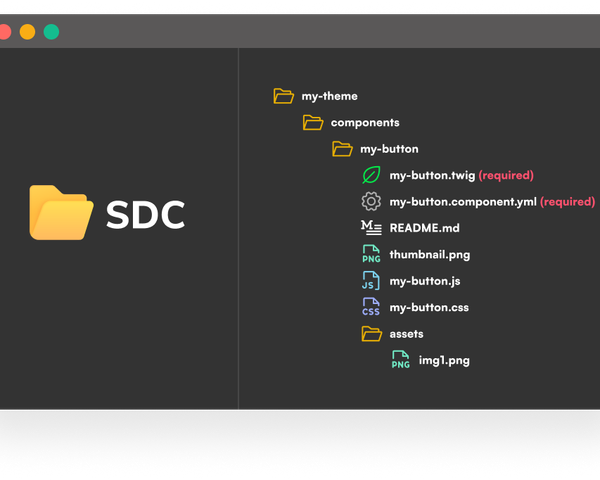
Single Directory Components (SDC) are the biggest change to Drupal theming in a decade, and one of the quietest. There was no page-builder launch, no new screen to learn, just a simple answer to a question Drupal front-end developers had been asking for years: why are all the pieces that make up one part of a page scattered across five different folders?