ExperienceKit: AI Landing Page Generation for Drupal - How It Actually Works

Describe the landing page you need in plain language. A few minutes later, it exists in your Drupal site: production-ready, on brand, and waiting for your review. That is the promise of an AI landing page generator for Drupal, and it is no longer a demo trick. It works, it is reliable enough for enterprise sites, and it changes how marketing and development teams divide their work.

This post is part of the ExperienceKit series. New to ExperienceKit? Start with the introduction, which the whole series builds on.
This article walks through the whole flow, end to end: what happens between the prompt and the published page, why generating from approved components is so different from letting AI make up a page from scratch, and what each team on a digital project gains from it.
What "AI landing page generation" means in a Drupal context
Most people's first contact with AI page generation is a consumer tool: type a sentence, get a website. It is impressive to watch, but what comes out is a one-off result, made up on the spot and looking however the tool decided that day. That is fine for a personal project. For a university, an NGO, or any organization with a brand book and accessibility rules, it does not hold up, and the page would need reworking before it could go live. The time you thought you saved goes back into fixing it.
Drupal teams need something different: AI that generates pages inside the CMS, using the site's real content model, real components, and real editorial workflow. The page that comes out should be indistinguishable from one a skilled site builder assembled by hand, because structurally it is the same thing. The AI's job is the assembly, not the invention.
That is the approach ExperienceKit takes. The AI assembles the page from a governed component library built on your brand, which is what makes the result production-ready instead of a starting point you still have to fix.
The prompt-to-page flow, end to end
Here is what actually happens when a content editor generates a page, step by step.
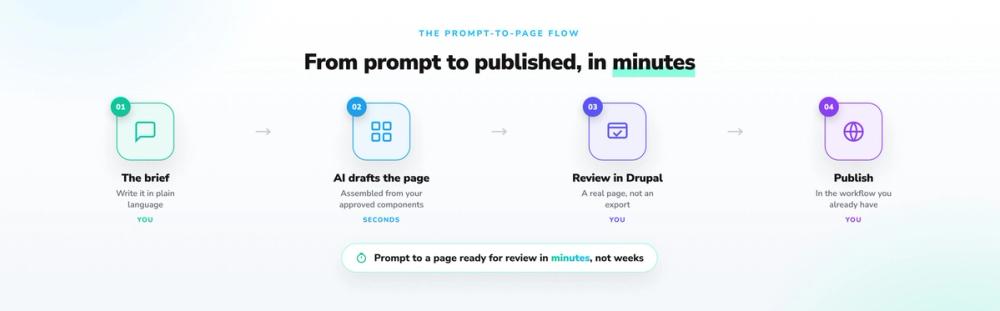
Step 1: The prompt (write it like a brief)
The input is the same brief you would have written for an agency or filed as a ticket. A typical prompt looks like this:
"Landing page for our spring open day on April 18. Hero with the campus photo style, a short intro about what visitors can expect, three highlight cards for campus tours, faculty talks, and student life sessions, a registration call to action, and an FAQ section at the bottom."
No special syntax, no technical vocabulary. The people writing prompts are the people who own the campaign: communications staff, marketers, program managers. If they can brief a colleague, they can prompt the system.
Step 2: Interpretation (structure, not pixels)
The AI reads the brief and works out the page's structure: what sections it needs, in what order, serving what purpose. A hero, an intro, a card group, a call to action, an FAQ. This is the same reasoning an experienced site builder does when reading a brief ("this asks for a three-up card section and a signup CTA"), except it happens in seconds.
The AI is not deciding what anything looks like. Every result stays on brand, because the component library it draws from is built to match your brand. The AI decides composition; the components decide appearance.
Step 3: Component selection from the approved library
For each section, the AI selects a component from the organization's design system. In ExperienceKit's case, that means BrandKit, a governed library of Drupal Single Directory Components (SDC) that we built, maintain, and stand behind. Every generated section is mapped to the appropriate component from the governed SDC library we provide.
This is what makes the difference. The AI does not invent anything from scratch. It builds pages from the components available in the library. If a component does not exist, it cannot make one up. Instead, a new component can be added to the library, ready for future pages, keeping branding and behavior consistent everywhere.
Step 4: Content population
The AI drafts the copy and places it into the components' fields: headline, body text, card titles, button labels. Because each component has a clear set of fields, the generated content lands in a clean, editable form, not locked into the layout. Every word stays a normal field an editor can change.
Step 5: Review in Drupal (a real page, not an export)
The generated page appears in your Drupal site as a draft, built from real components with real fields, subject to your normal editorial workflow. Editors read it the way they would read a first draft from a colleague: adjust the headline, swap an image, tighten the FAQ answers. Nothing about this step is new to the team: it is standard Drupal content editing, on a page that arrived assembled instead of empty.
This human review step matters. The AI produces the draft; a person decides it is ready. Speed comes from removing the waiting and the assembly, not from removing judgment.
Step 6: Publish
Approvals happen in the workflow you already have. The published page lives on your domain, in your analytics, in your CMS, with your caching and your hosting. There is no shadow microsite, no external page builder subscription, no content stranded outside Drupal. When the campaign ends, the page is archived like any other node.
Total elapsed time from prompt to a reviewable draft: minutes. The part of the process that used to take weeks (briefing, queueing, building, revising layout) is gone. The part that should always take human attention (is this the right message, is it accurate, are we ready to publish) remains.
Building from approved components vs. generating from scratch: why the difference is everything
The distinction deserves precision, because from a distance the two approaches look similar: both take a prompt, both produce a page. Underneath, they have little in common.
What generating from scratch produces
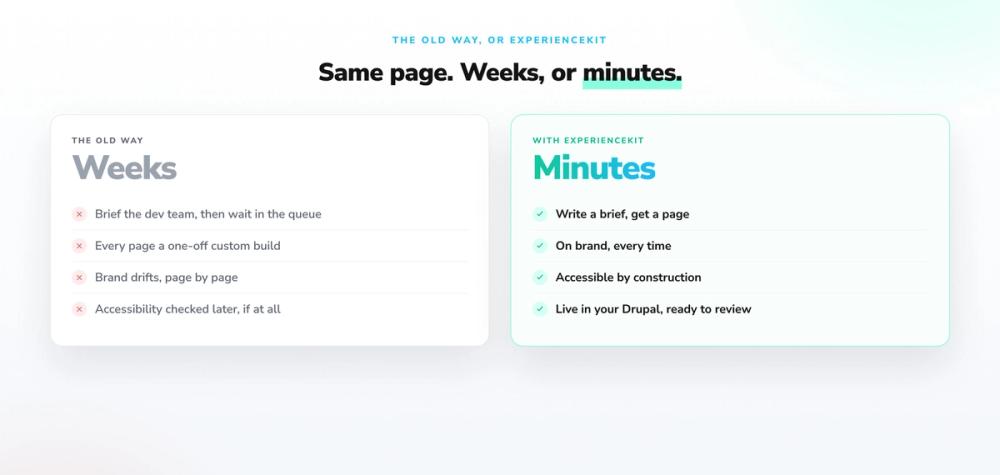
A general-purpose AI asked for a landing page makes up something new every time: its own layout, its own styling, its own interpretation of your brand. Three consequences follow.
Brand drift is built in. The model approximates your visual identity from whatever it can infer. Every generated page is a slightly different guess. Multiply by fifty campaign pages and you have fifty variations of your brand, none of them quite right.
Accessibility is a lottery. Heading order, contrast, focus states, ARIA usage, keyboard behavior: each generated page handles these however the model happened to handle them that day. Every page needs its own accessibility audit, which nobody budgets for, so most pages never get one.
Nobody can maintain it. When the brand refreshes or a legal disclaimer changes, there is no single place to make the update. Each page is its own one-off build. The upkeep gets heavier and heavier until starting over starts to feel like the only option.
What component-constrained generation produces
When the AI can only assemble approved components, those failure modes become structurally impossible rather than policy-discouraged.
Brand consistency by construction. Every hero on every generated page is the hero component: the one built into the governed SDC library. There is no "slightly off" version because there is no mechanism for producing one.
Accessibility decided once, inherited everywhere. We built every component with accessibility in mind from the start: correct structure, readable contrast, keyboard support. Every page the AI generates inherits that work automatically. The component library is audited once, and every generated page benefits from it.
One place to change everything. Update a component, and every page built from it, human-assembled or AI-generated, reflects the change, accessibility fixes included. A bigger structural change is a larger decision: it deserves careful review, and sometimes the right answer is a new component rather than reshaping an existing one. The component library stays the single source of truth, and AI generation strengthens that.
This is why the constraint is a feature rather than a limitation. Generic AI builders compete on how much they can invent. A governed generator competes on how reliably it produces pages your organization can actually publish.
What this changes for each team
For marketing and communications: the developer queue stops being the bottleneck between an idea and a live page. A campaign page for next week's event is a prompt this afternoon and a review tomorrow morning. Teams that used to plan campaigns around build lead times start planning them around the campaign itself.
For developers and architects: the design system finally holds. Instead of watching editors work around it (or paste in ungoverned AI output), developers define the component library and the AI operates strictly inside it. Developer time shifts from assembling one-off pages to improving the components every page is made of.
For leadership: this is an AI initiative you can describe in one sentence to a board or a governance committee: AI generates the pages, everything it produces comes from our approved components, and every page passes through our normal editorial review. The result is fast, on brand, and auditable.
What a good prompt looks like
Prompting a governed generator is closer to briefing than to prompt engineering. A few patterns that produce strong first drafts:
- State the goal, not just the content. "A donation page for our winter appeal, optimized to get first-time donors to give" produces better structure than a bare list of sections.
- Name the audience. "For prospective graduate students" or "for returning donors" shapes tone and emphasis.
- List the sections if you have opinions about them. If you do not, the AI proposes a sensible structure and you edit from there.
- Iterate in follow-ups. "Make the hero more urgent" or "add a testimonial section before the CTA" refines the draft the way feedback rounds refine an agency deliverable, in minutes instead of days.
Frequently asked questions
Can the AI produce something off brand?
Not structurally. Every element on a generated page comes from the component library, rendering the styles and patterns built into it. What the AI writes into those components (headlines, body copy) is why human review remains part of the flow, exactly as it is for human-written drafts.
Does this replace developers or content editors?
No, and it should not. Developers do more consequential work: designing and maintaining the component system every page depends on. Editors and marketers keep full ownership of message, accuracy, and the publish decision. What disappears is the waiting and the repetitive assembly, the parts of the job nobody misses.
What happens to the pages if we stop using the platform?
They are standard Drupal pages built from standard SDC components in your codebase. Your design system and your content remain yours, on your hosting, with no proprietary rendering layer between you and your pages.
Does this require rebuilding our Drupal site?
No. Governed generation sits on top of a component library, and most established Drupal sites already have the raw material for one: recurring page sections that developers have built and rebuilt over the years. Formalizing those into an approved SDC library is a scoped project, not a replatform, and it pays for itself independently of AI: it is the same design-system investment that improves consistency and maintenance for human-built pages too. Once the library exists, the AI generation layer works with your existing content model, editorial workflow, and hosting.
How is this different from Drupal Canvas?
They are complementary and build on the same foundation. Canvas gives editors a visual workspace for creating pages with Drupal SDC components. ExperienceKit starts one step earlier: instead of beginning with a blank page, the AI assembles a complete first draft from a prompt using the same component library. Editors can then review, refine, and publish rather than build every page from scratch. In both cases, the real foundation is the SDC library, making it the long-term investment that powers both AI-assisted and manual page creation.
See it happen
Reading about prompt-to-page takes longer than watching it. The best way to evaluate an AI landing page generator for Drupal is to bring a real brief (an actual campaign your team has queued) and watch it become a reviewable page in minutes. Book a demo of ExperienceKit and bring your hardest landing page brief.
Related posts

Your marketing team needs a landing page for next month's campaign. Today that means a brief, a ticket, a spot in the developer queue, and a few weeks of waiting. ExperienceKit turns it into a sentence. Describe the page, and AI generates it in your Drupal site: production-ready, on brand, and built entirely from a governed component library, one built on your brand and delivered as part of the solution. This post introduces what ExperienceKit is, why we built it, and what the rest of this series will cover.
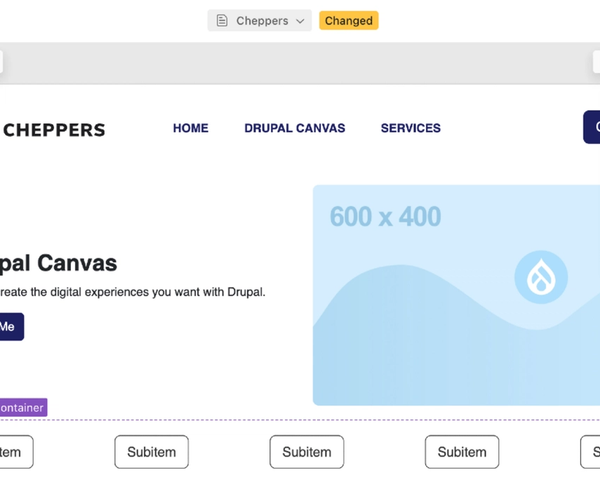

Drupal has always been powerful. That’s why organizations choose it for large, complex websites. But let’s be honest—building and editing pages in Drupal has never been as simple as it could be. Marketing teams often depend on developers for every layout change or new page, and that slows everything down. That’s now starting to change with Drupal Canvas (previously called Experience Builder) and Single Directory Components (SDC). Together, they make Drupal feel modern, visual, and far more approachable for editors.